

Journalism That Can Stop a Bullet

View this email in your browser

This story has a problem. That’s a thought most editors have (frequently) and it’s one that entered my mind when I read Linda Rodriguez McRobbie’s initial pitch for what would become The People vs. Rubber Bullets. To explore the devastating issue of law enforcement’s misuse of less-lethal munitions, she proposed telling a victim’s story. The problem: In the five decades since rubber bullets were invented, their misuse has resulted in thousands of victims. How could we possibly pick just one?
In researching an answer that question, something quickly became clear: The massive amount of less-lethal deaths and injuries was a critical, newsworthy part of this story. This phenomenon is tragically underreported, and no one has ever taken a comprehensive look at the carnage these policing tools have created. So, instead highlighting one victim, we needed to show as many as we could. The best way to do that, we decided, was through photos — a staggering amount of photos.
In Part V of The People vs. Rubber Bullets, out today, Rodriguez McRobbie tells the story of Linda Tirado, a journalist who was blinded while photographing Minneapolis police officers in the protests following the 2020 killing of George Floyd. Tirado is no hack, as Rodriguez McRobbie writes. “After the police shooting of Michael Brown on August 9, 2014, she spent weeks living in an encampment in Ferguson, Mo. The streets were alive with restless, justified anger, and Tirado wanted to tell the stories of the teenagers and young people navigating them. This was, she felt, her vocation: a photojournalist and writer reporting from the front lines of civil conflict.”
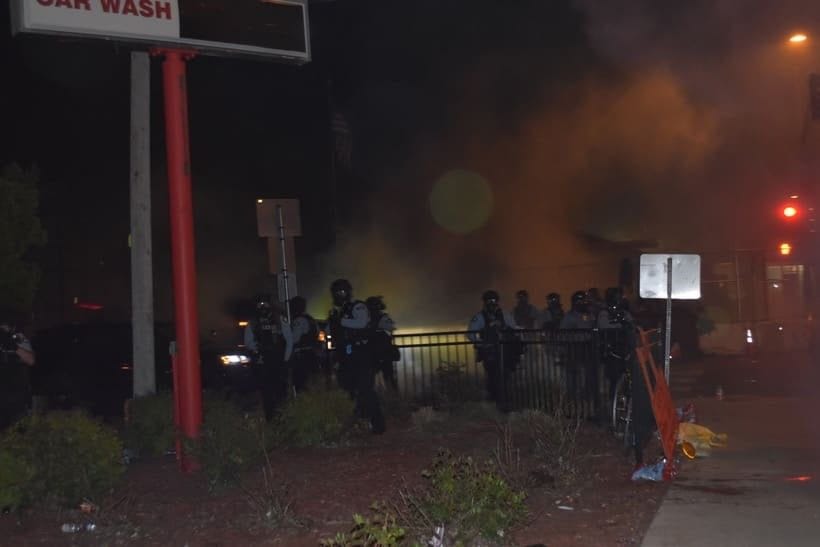
The last photograph Linda Tirado took before being blinded. In the center-left of the frame, the police officer who shot her in the eye aims his 40mm launcher at the camera. Image courtesy of Linda Tirado
It’s haunting to look at the last image Linda Tirado took before she was blinded. “Tirado was there to document the uprisings in the wake of George Floyd’s death under the knee of a Minneapolis police officer,” Rodriguez McRobbie writes. “What she witnessed, through the viewfinder of her camera, was her own tragedy, captured in a haunting series of ones and zeroes that marks the end of one kind of life and the beginning of another.”
Tirado was rushed from the scene of her shooting to the hospital, where she underwent life-saving surgery, but has not been the same since. Her story explores the injustice victims endure by having to sue the police for damages because the criminal justice system does not hold law enforcement accountable. The civil litigation process also prolongs the agony of these victims — to the police’s benefit. “I couldn’t even keep a journal,” Tirado says. “I couldn’t even write about what happened to me because it was discoverable.” As a working writer, that means she couldn’t even do her job.
Read Part V of “The People vs. Rubber Bullets” here:
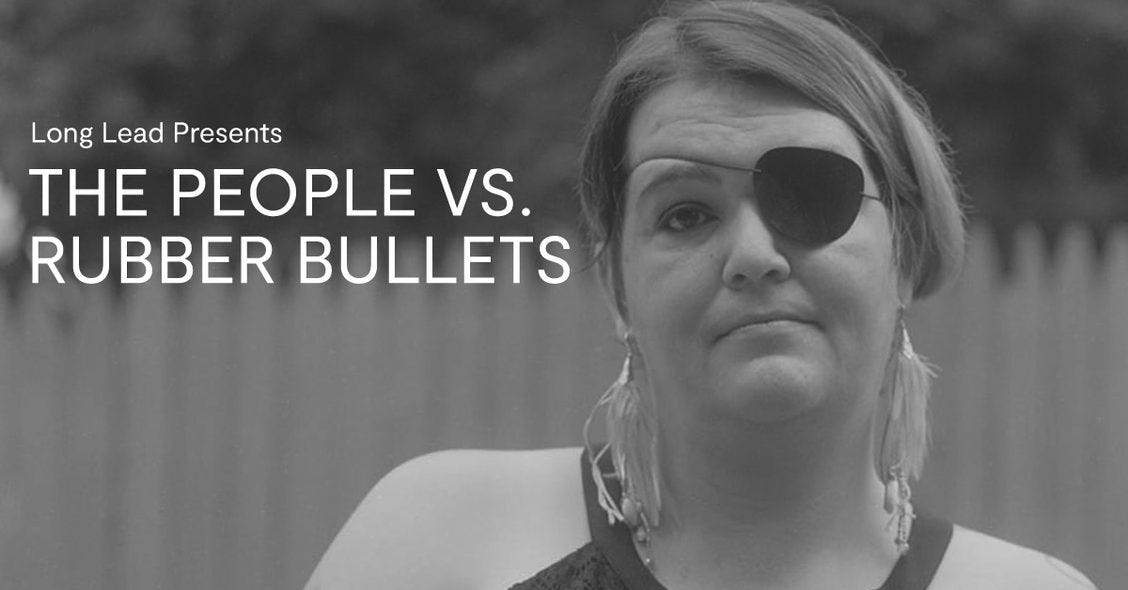
These details are important context wrapped around Tirado’s final photograph. Hers is one of more than 350 pieces of media that Long Lead has packed into this multi-installment feature. We’re using so many photographs because the misuse of less-lethal projectiles is something that’s endured for 50 years. We even made A History of Violence, a visual timeline that chronicles how these policing tools first came to power and then slowly took over law enforcement’s crowd control tactics.
Like the endemic gun violence that has warped America’s collective senses, people only notice the misuse of less-lethal weapons every now and again, like when protests get heated and law enforcement unloads on demonstrators. That’s why longform, enterprise journalism like “The People vs. Rubber Bullets” is so vital. The next time this happens, there will finally be a history of less-lethal abuse that people can point to. “And there will be a next time,” Tirado says. She’s right — and that’s why the problem with this story persists: There are already too many victims.
Thanks for reading…
John Patrick Pullen
Founding Editor, Long Lead
PS: “The People vs. Rubber Bullets” isn’t our first explainer spanning multiple decades. Long Shadow: 9/11’s Lingering Questions, a podcast we made with host Garrett Graff, explores the causes and effects of the September 11 terrorist attacks. The podcast was recently nominated for a Signal Award for Best History Podcast. Voting for the award is open until December 22, and we’d love your support for this breakthrough, top-ranked limited series. Please vote here for Long Shadow to win a Signal Award!
Read “The People Vs. Rubber Bullets”

Copyright (C) 2022 Long Lead, LLC. All rights reserved.
Want to change how you receive these emails?
You can update your preferences or unsubscribe