Don't judge: Podcast producer Ryan Sweikert's secret to pulling the truth out of complex subjects
The producer behind 'Long Shadow: Breaking the Internet' sees the humanity in everybody — even the murderers and insurrectionists he's interviewed along the way.
The amount of wrangling and shaping it takes to develop a podcast can be overwhelming. Sorting through hours, if not days, of recorded interviews. Sifting through vast, disorganized databases of archival sound. Reviewing countless research documents often spread across both digital and paper files. The brainstorming. The planning. The interview scheduling. Then there’s the near endless options for music and sound effects. It’s not a job for everyone, but for Ryan Sweikert, it’s a perfect fit.
Despite producing some of the most gripping nonfiction podcasts around, Sweikert got his start as a fiction writer in college. That changed in 2016 when he attended the Transom Story Workshop, a nine-week program that trained some of the audio world’s most sought-after producers until it went on hiatus in 2019.
The throughline between fiction and audio work? “Story structure,” says Sweikert. “For me, writing fiction is about being really specific about what you want to include and exclude in a story. That still informs what I do with podcasts. Obviously it’s different when you’re dealing with real people and real interviews. It makes it harder, but I prefer it that way.”
Sweikert has produced two seasons of the award-winning, Long Lead-produced, history podcast Long Shadow, hosted by Pulitzer finalist and investigative reporter Garrett Graff. Sweikert came to the show in its second season in 2022 as a senior producer with Campside Media, which handled production on the still-relevant Long Shadow: Rise of the American Far Right. After a season three sabbatical, Sweikert returned to work with Long Lead on the podcast’s fourth season, Long Shadow: Breaking the Internet.
Connecting the dots between the 1993 raid on the Branch Davidian compound in Waco, Texas and the January 6, 2021 attack on the U.S. Capitol, Long Shadow: Rise of the American Far Right accomplishes what other media and politicians couldn’t. It provides both cause and context for America’s current moment and Donald Trump’s second administration. It also won coveted accolades, including the 2024 National Edward R. Murrow Award honoring outstanding achievements in broadcast and digital journalism.
Long Shadow’s fourth season takes on an equally ambitious topic: How the internet, which started out as the ultimate connector turned into anything but. Here Sweikert discusses his work, the process of creating the fourth season of Long Shadow, and what exactly goes into being a podcast producer. —Jenna Schnuer
Signaling Excellence: Vote for Long Shadow in the Signal Awards
Through three seasons of Long Shadow, the podcast has won five Signal Awards. With the release of season four, a sixth Signal would be good — but eight would be great.
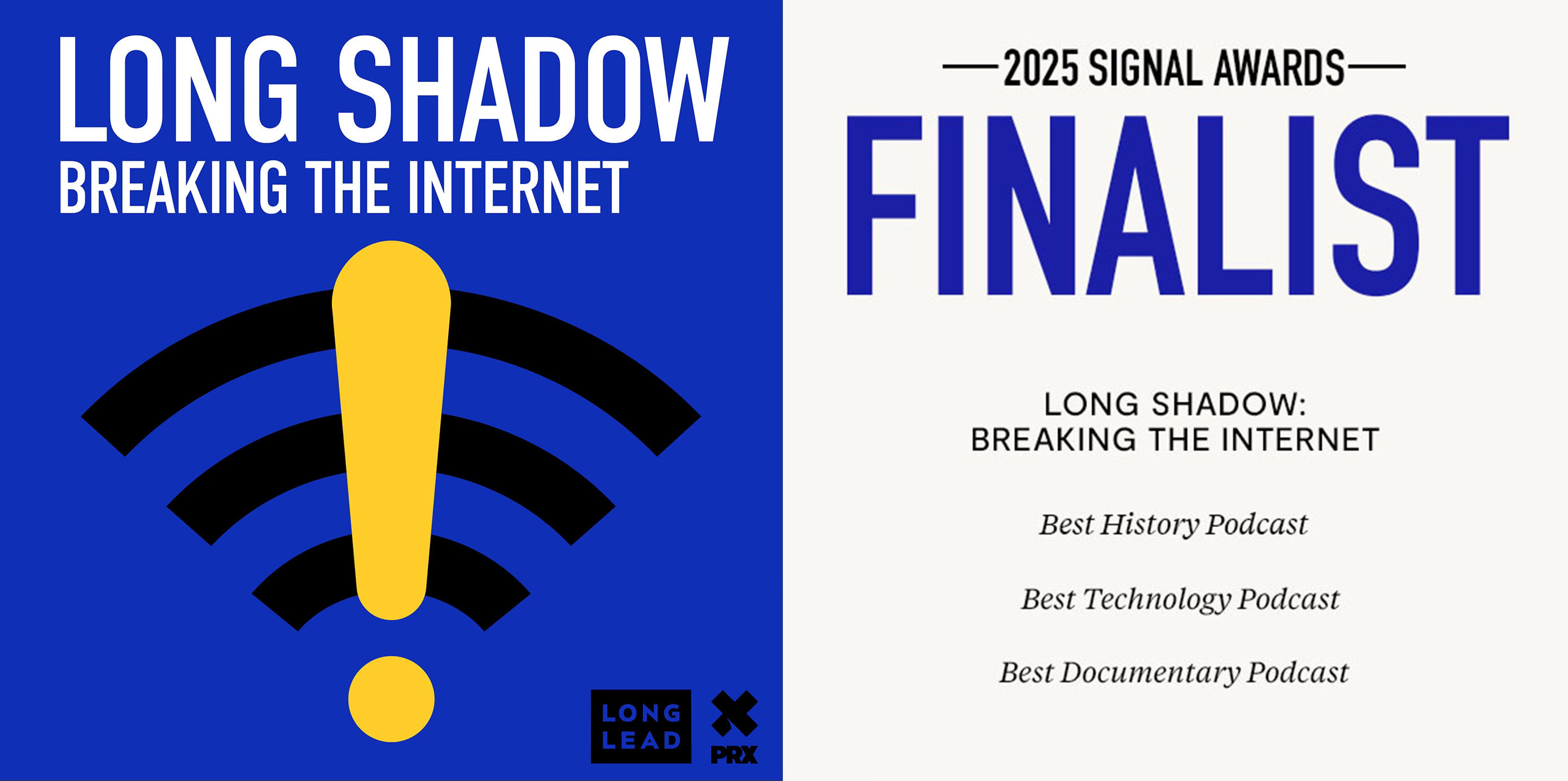
Last week the Signal Awards announced that Long Shadow: Breaking the Internet is a finalist in three categories. And now through October 9, listeners can propel the show to titles by voting for the podcast here:
Check back in on October 15, when winners of the Signal Awards will be announced, and catch up on Long Shadow: Breaking the Internet wherever you get your podcasts.
Let’s get right to one of the great questions of our time: What does a podcast producer actually do?
On this project, it was really a little bit of everything and just keeping all the trains running on time. That starts with setting the production schedule, finding sources, sourcing a ton of archival material — which we find all over the internet — prepping for the interviews, and conducting the interviews.
We split the interviews pretty much in half. So Garrett will ask his questions and I’ll ask mine, about an hour each. Sometimes, for smaller sources, I’m tracking them down and reaching out to them and interviewing them, and just doing it all. But for the bigger interviews, the two of us sit in on those.
Then we have big editorial meetings to lay out the season and think about how these episodes connect. The big thing I was pushing this time was focus and throughline. We did that really well in season two because it was something that Garrett had been thinking about and had already outlined, so it was really clear from the get go. This season with the internet, it was not that clear at all when we started.
Then I put the episodes together entirely by myself. I scored them with music. I did some sound design.
What worried you most when you started working on Long Shadow:Breaking the Internet?
I remember telling people early in the process that I was doing a show about the internet, and they were just like, “[The entire internet?] OK.” And I’m like, “Yeah, yeah, I know.”
Then I think there was some worry about making it too dark. Of course, it does end in a dark place, because we’re in a dark place right now. But I think we were able to strike a balance, at least in the earlier episodes, with hopeful moments for the internet and funny moments and all those things.
How did the show evolve from the basic idea of how the internet changed over time into the final seven-part series?
It’s just a lot of shaping. These are all topics we wanted to hit including Y2K, the election of Barack Obama, and the Arab Spring. My job then is to find people to tell those stories through. That’s the major part of the process, figuring out not only how do we tell the story of Howard Dean’s political campaign and make it interesting in 2025, but how do we even find somebody to tell that story through? Because with audio, you always have to tell it through the eyes of somebody who was there.
How do you decide which stories to focus on for each episode?
We’re just sort of figuring it out along the way. The people that Garrett usually came with are academics or historians or journalists. The people I’m always interested in talking to are just regular people who are going through this stuff. For example, in the Arab Spring episode, I really wanted to get one of the activists who was on the ground using the internet in this way to overthrow this regime. We ultimately did. It took a really long time, but we got one of the main guys, Ahmed Maher.
What do you do when you can’t find that one person you really need to tell the story?
We did this story in episode five about the Internet Research Agency, the Russian troll farm, and I really wanted someone who worked there. We got really close on a couple of people. One of them went on to work for Voice of America in Russia. But I found him right when public media was getting defunded. We almost got him, but he was just rightfully nervous to speak with us about this particular topic. So we ended up not getting anybody for that one. Then it becomes about telling that story without somebody who is on the inside. We just ended up doing it in narration.
Long Shadow: Watch the internet’s outrage machine in action
Long Shadow: Breaking the Internet retraces the story of mankind’s greatest invention, a tool that gave everyone access to all the world’s information and unlocked democracy across the globe. But it’s also about the biggest crisis facing society today: how the web’s unlimited feed of data morphed into a firehose of hoaxes, conspiracy theories, and lies that divided Americans over things we once agreed on, like science, diversity, and even democracy itself.
In this video, built from audio produced by Sweikert in the latest season of Long Shadow, the result of online outrage is on full display. Watch this and other videos on Long Lead’s YouTube channel.
What do you think is the most successful moment or episode of the season?
It’s in episode six. We got this woman, Pamela Hemphill — her name just got thrown out in one of the meetings about, “OK, who is going to show us January 6?” And we need to find a person who sort of goes down the rabbit hole of the internet during this time that ends up at [the insurrection]. That was Pamela, also known as the MAGA Granny.
She was a really tough interview, I think, because she’s done a complete 180 on who she was then. Now she’s very liberal and very outspoken about all the things that are happening now under Trump, and remorseful about what she did [on January 6] and the fact that she was there. She just feels like she was brainwashed. So [for] a lot of her interview, at least in the first two hours Garrett and I did, it was really hard to get her back into that mindset of who she was then and what was driving her. And what ultimately leads her to end up in the insurrection.
How did you get her there?
It took a really long time. I did a second interview with her by myself.
I figured out that in the beginning, this was just about community for her. [During the pandemic,] she was lonely, like a lot of people. She wanted to get out of the house and she would go to these protests at the Boise capitol building, anti-lockdown protests and anti-mask protests. I think through her you could really start to understand, in a way that I hadn’t really understood before, why these people were out there doing this. One of the things she said was, “They tell you that you’re saving the country and you believe that.” And why I think she’s the best part of the show, is you get to go down the whole rabbit hole with her, from basically just being somebody who gets their news from Facebook to somebody who ends up pressed against the gates on January 6 at the very front.
She was going live the entire day on Facebook, so all of her tape from that day is available. And so you’re doing this thing where you’re weaving your interview with the real thing that actually happened which is, to me, like the gold standard. If you have the full audio of some major event, and you also have them in the interview describing what they felt in the moment, it’s just this really visceral sequence in the show where she is rushing the Capitol with everybody else. She gets trampled. Then she gets pulled aside, dragged out of there by Capitol police officers who kind of save her. She gets trampled but then she’s still hanging around. She’s going into the Capitol, walking around, even though she got trampled and she got hurt. I think that kind of speaks to the lack of logic that went into a lot of what people did there.
What’s it like for you to listen to somebody talking about doing terrible stuff?
It’s not hard for me. I’ve interviewed a lot of people who have done terrible things. I’ve interviewed mafioso talking about murders they committed. It’s going to sound a little corny, but I just see the humanity in everybody. Judgment from me is not going to get this person to tell the truth about what happened. It’s the opposite. You have to sort of just look at them as a human being who made a mistake. Or who got caught up in a bad moment. In the show, it’s not like we present her in a sympathetic view, but we do try to explain through her reasoning how she got into this. Because I don’t think probably in 2018 this was anybody’s plan.
I was Ryan's classmate in grad school and remember him as a terrific storyteller. How cool to randomly stumble across this interview with him in my inbox. Look forward to checking out the Long Shadow podcast!




I was Ryan's classmate in grad school and remember him as a terrific storyteller. How cool to randomly stumble across this interview with him in my inbox. Look forward to checking out the Long Shadow podcast!